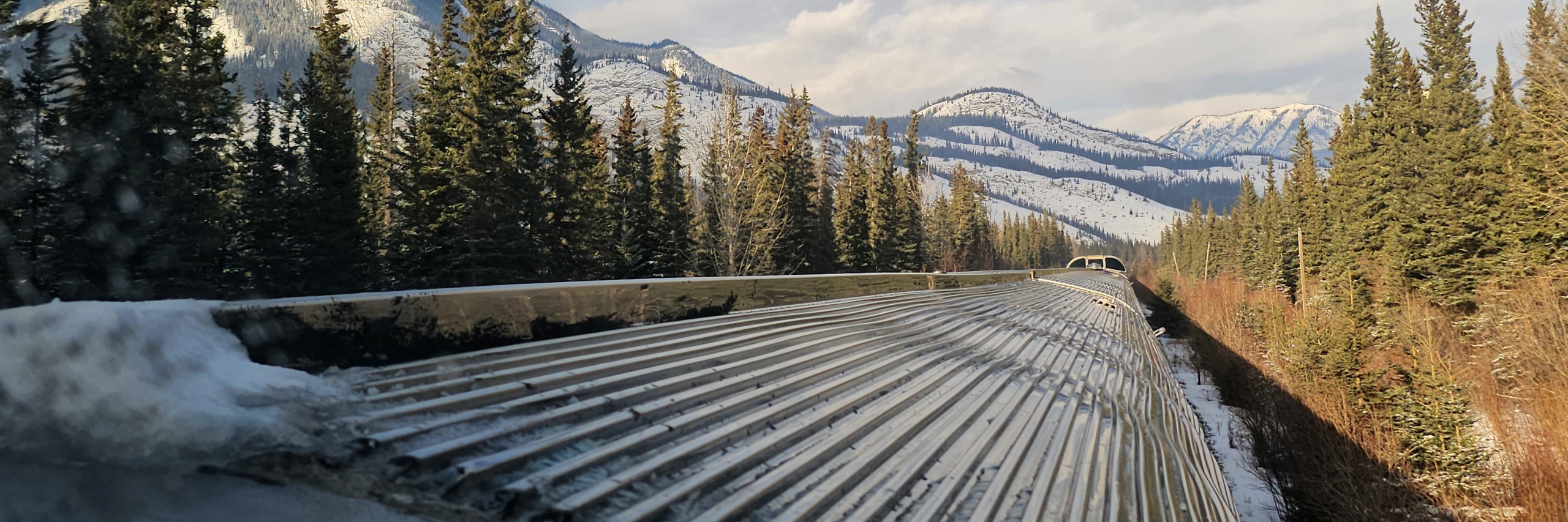
The Canadian
The Canadian is a transcontinental passenger train operated by VIA Rail between Toronto Union Station and Vancouver Pacific Central Station in Canada — North America's longest scheduled passenger rail journey at 4,406 kilometres.
Journey Overview
Essential information for planning your journey
The Experience
What makes this journey unique
The Experience
Life aboard The Canadian settles into a relaxed rhythm structured by meal calls in the dining car and changing landscapes outside the observation dome. The journey demands a complete departure from modern travel haste.
What to Expect
Mornings often begin in the Skyline Car dome watching mist rise over boreal lakes or prairie grain elevators before heading to a hot breakfast prepared by the train's chefs. Afternoons pass with reading, visiting the Park Car lounge, or listening to onboard musicians.
Along the Way
The shared isolation from constant digital connectivity fosters genuine conversation among travelers from around the world. By the time the train climbs into the Canadian Rockies, the shared experience creates a camaraderie rarely found on contemporary commercial transit.
Route & Key Stops
Train 1 operates westbound from Toronto to Vancouver in 97 hours 5 minutes departing Wednesdays and Sundays; Train 2 runs eastbound from Vancouver to Toronto on Mondays and Fridays in 92 hours 29 minutes, with eastbound departures calling at Parry Sound, North Bend, Katz, Agassiz, and Mission Harbour.
Toronto Union Station → Vancouver Pacific Central Station
Canada's primary rail hub anchors the journey from the historic downtown terminal opposite the Fairmont Royal York Hotel.
Muskoka lakes region stop at rail mile 98 north of Lake Simcoe.
Georgian Bay junction marking the southern boundary of the Canadian Shield.
Northern Ontario mining center serving the world's most productive nickel basin.
Historic railway division point surrounded by exposed granite bedrock and northern muskeg peatlands.
Remote flag stop serving hunting camps within the thick boreal pine forest.
Unstaffed request halt providing access to backcountry canoe routes and fishing lakes.
Isolated request stop on the Canadian National main line through dense timber country.
Boreal wilderness request point along the upper Wanapitei River drainage.
Small forestry settlement on the southern shore of Duchabani Lake.
Former steam-locomotive servicing stop developed around northern forestry and lumber operations.
Request-only rail halt on the shores of Kapuskasing Lake.
Rail yard and divisional outpost established to support pulp and lumber mills in northern Ontario.
Forestry flag stop positioned near the headwaters of the White River.
Unincorporated logging community in the Thunder Bay District.
Bilingual lakeside community along northern Ontario's primary historic fur-trade canoe routes.
Former National Transcontinental Railway division point serving remote fly-in northern communities.
Remote flag stop on the edge of the Ogoki River watershed.
Request station adjacent to the Gull Bay First Nation territory.
Boreal request stop situated near the north shore of Lake Nipigon.
Northern floatplane base and rail outpost north of Lake Nipigon.
Flag station near Smoothrock Lake within the Wabakimi wilderness area.
Remote crossing over the Allanwater River popular with backcountry canoeists.
Flag stop at the head of the Flindt River waterway.
Mining and prospecting community along Ontario Highway 599.
Major transportation crossroads on the English River and Lac Seul water networks.
Unstaffed request stop in the Kenora District boreal forest.
Highway transfer stop for road traffic heading north toward the Red Lake gold mining district.
Request halt set within a steep granite cut along the railway line.
Backcountry flag stop giving rail-only access to isolated lake cottages.
Winnipeg River crossing celebrated for historic sport fishing lodges.
Request stop on the shores of Ottermere Lake accessible primarily by rail or boat.
Western Ontario flag halt near the Manitoba provincial boundary.
Unstaffed request point along the rugged Canadian Shield lake country.
Remote rail access point serving seasonal cabins in eastern Manitoba.
Manitoba boundary flag stop surrounded by boreal wetlands.
Isolated junction where the Canadian National line crosses the Whiteshell wilderness.
Whiteshell Provincial Park stop popular with cottagers and canoeists.
Whitemouth River crossing marking the transition from bedrock forest to agricultural prairie.
Beaux-Arts union terminal where the train undergoes a scheduled maintenance halt and full crew change.
Agricultural center in the fertile Central Plains of southern Manitoba.
Planned railway divisional town named after Grand Trunk Pacific Railway president Charles Melville Hays.
East-central Saskatchewan station near the mineral-rich waters of Little Manitou Lake.
Saskatchewan's 'City of Bridges' where the tracks cross high above the South Saskatchewan River.
Railway junction community famous for its proud agricultural prairie heritage.
Prairie farming center situated above massive commercial underground salt deposits.
Historic cattle ranching and oil town marked by working pumpjacks.
East-central Alberta farming community founded by early Scandinavian settlers.
Provincial capital stop providing direct connections across central Alberta.
Foothills community midway between the provincial capital and the front ranges of the Rockies.
Athabasca River valley settlement bordering the eastern gate of Jasper National Park.
Heritage stone station inside Jasper National Park surrounded by soaring mountain peaks.
Mountain valley town situated at the meeting of the Rocky, Cariboo, and Monashee ranges.
North Thompson River settlement surrounded by heavy inland rainforest and mountain peaks.
Gateway municipality to the wilderness canyons and waterfalls of Wells Gray Provincial Park.
Major divisional servicing halt in the arid Thompson River valley.
Semi-desert canyon stop amid sagebrush hills along the Thompson River.
Fraser Canyon community set above the turbulent river rapids of Hell's Gate.
Historic fur-trade and gold-rush settlement at the confluence of the Fraser and Coquihalla rivers.
Agricultural center in the fertile lower Fraser River valley.
Fraser Valley hub framed by Mount Baker and extensive berry farms.
Pacific terminus ending at the 1919 neoclassical Pacific Central Station near False Creek.
Journey Highlights
Key scenic features and landmarks along the route
Classes of Service
Choose the level of comfort that suits your travel preferences
Economy Class
Reclining fabric seats with fold-down tray tables, power outlets, and footrests in open coaches, with food available for purchase.
Sleeper Plus Class
Choice of curtained upper and lower berths or a private cabin for one, two or three, with freshly prepared dining car meals, lounge access and shared showers.
Prestige Class
Private cabin 50% larger than a Sleeper Plus cabin for two, with an extra-large window, a leather L-shaped couch that becomes a Murphy bed for two, heated floors and walls, a flat-screen TV, a private washroom with shower, and all-inclusive meals and bar service.
Onboard Experience
What to expect once you are aboard
Is This the Right Train for You?
An honest look at who gets the most out of this journey
How to Experience This Journey
Our specialists' approach to getting the most from this route
Travel westbound from Toronto to Vancouver to experience the dramatic progression from boreal shield to prairie before entering the Rockies
Choose a Sleeper Plus cabin for two or cabin for one for the ideal balance of privacy, bed comfort, and inclusive dining
Embrace potential freight delays as part of transcontinental rail travel and plan an extra buffer night at your destination
Where This Trip Can Go Wrong
Common mistakes and how to avoid them
Things to Know Before You Book
How This Train Compares
VIA Rail and private tour operators offer other prominent train journeys across Canada that differ significantly in scope and routing.
The Ocean connects Montreal and Halifax overnight across Maritime Canada, offering a shorter coastal itinerary compared to The Canadian's multi-day transcontinental route.
The Skeena operates daytime-only service between Jasper and Prince Rupert through northern British Columbia, requiring an overnight hotel stay in Prince George.
Rocky Mountaineer operates daylight-only tourist rail excursions through the Canadian Rockies with overnight hotel stays in Kamloops rather than onboard sleeper accommodation.
Have a question about The Canadian?
Frequently Asked Questions
The scheduled journey takes about 97 hours 5 minutes westbound (departing Toronto Wednesdays and Sundays at 09:55 and arriving in Vancouver at 08:00 on day 5) and 92 hours 29 minutes eastbound (departing Vancouver Mondays and Fridays at 15:00 and arriving in Toronto at 14:29 on day 5), spanning four nights. Freight traffic on Canadian National tracks can add hours of delay.
No Wi-Fi internet service is provided aboard The Canadian. Cellular phone reception also drops for hours at a time through northern Ontario's boreal shield and across the Rocky Mountain passes. Travelers should download entertainment, reading material, and offline maps before boarding the train.
Meals are included for passengers traveling in Sleeper Plus and Prestige classes, but not in Economy Class. Sleeper passengers dine on multi-course meals prepared fresh onboard by chefs in the dining car. Economy passengers may purchase hot meals, snacks, and drinks à la carte throughout the trip.
Yes. Sleeper Plus passengers use shared showers in the sleeping cars, which are sanitized after each use. Prestige Class cabins have their own private washroom with shower.
VIA Rail opens ticket bookings up to 11 months, or 331 days, prior to scheduled departure. Because sleeper cabins and peak summer departures sell out well in advance, reserving early is strongly recommended. Booking directly on the official VIA Rail website provides real-time cabin availability and scheduling.
The Canadian crosses four Canadian time zones between Toronto and Vancouver. Passengers travel through the Eastern, Central, Mountain, and Pacific time zones during the four-day transcontinental trip. Train crews announce time zone adjustments as the train progresses west or east across provincial boundaries.
Checked bags may weigh up to 23 kilograms (50 pounds) and measure up to 76 x 48 x 30 centimetres. Sleeper Plus and Prestige fares include two checked bags; Economy includes one. Bags between 23 and 32 kg, or between 154 and 180 linear centimetres, carry a $25 fee per item and direction. Pack a compact overnight bag for your cabin and check larger suitcases.
Accommodations and lounges are housed in refurbished stainless-steel streamliner cars built by the Budd Company, which entered service in 1955. These heritage cars include Manor and Château sleeping cars alongside Skyline and Park dome observation cars. VIA Rail maintains this historic fleet for transcontinental service.
Only service animals ride in passenger cars on The Canadian. Household pets travel in a carrier in the baggage car, and that space must be reserved at least 48 hours before departure.
Yes, Sleeper Plus and Prestige Class passengers can use the VIA Rail Business Lounge at Toronto Union Station before departure. Economy Class travelers do not have access to this station lounge.
The Verdict
The Canadian is North America's premier long-distance train, ideal for travelers wanting to experience the vast geography of Canada from vintage 1950s streamliner equipment.